
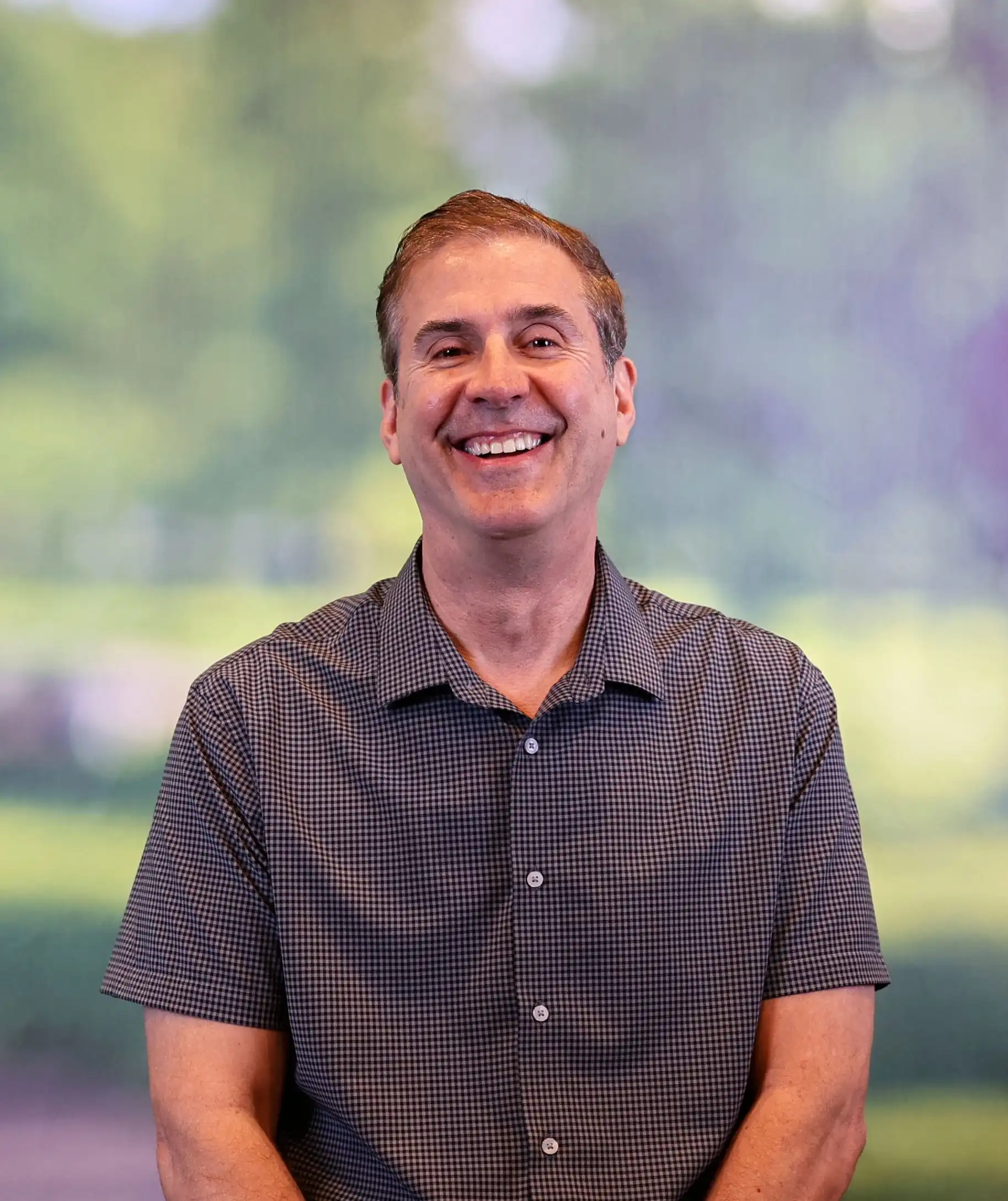
“Shalom!”
Nothing from the other end.
I moved to a different area of the building. I even tried holding my phone farther away.
“Shalom!”
“Shalom to you too, sir!”
Got him! Or so I thought.
More silence. Then faint crunching.
“Sorry I lost you. I just woke up. I hope you don’t mind, but I’m eating some Fruity Pebbles while we talk. Breakfast of champions.”
It’s 5:05 p.m., by the way.
Shalom Korn jokes often and laughs easily, yet he isn’t afraid to shed a tear in public — especially when discussing the health challenges of children he cares for as an emergency room nurse. You might say he’s the paragon of a paradox.
Outgoing, yet reflective.
A non-traditionalist in a traditional field.
A mashup of sense, sensibilities, and sensitivity.
While some might call his story complex, he says it isn’t complicated at all.
Life is precious and life is beautiful. I just want to make the most of the short time I have here.”
So far, so good.
Check that.
So far, so fascinating.
IN THE BEGINNING...
Shalom Korn joined the human race in October 2001, delivered in the maternity ward of Columbia University Irving Medical Center in New York City.
“Shalom, like the greeting. Korn, like the band,” is how he introduces himself. “I don’t have a middle name, and there’s no interesting story behind it. I just don’t have one.”
He’s the eldest of four children born to Joseph and Deborah Korn:
•His brother, Akiva, is 20 and lives in Jerusalem
•Sister Avigayil, 17, is a high school senior
•And another brother, Shmuel, 15, is a freshman in high school
The Korn family dwelled in Queens until Shalom was 4, then settled in Bergenfield, New Jersey, a borough of 28,000 residents located 15 miles from Manhattan. Its most famous son is Bleachers frontman and Taylor Swift songwriter Jack Antonoff. Bergenfield also is known as the fourth safest town in America.
Shalom just calls it “home,” and he continues to live with his family in a four-bedroom house on South Prospect Avenue, nestled in the heart of a strong Jewish community. It offers easy access to Palisades Medical Center, where he tends to patients; the five ambulance companies he drives for as an Emergency Medical Technician; and William Paterson University, where he’s pursing a bachelor’s degree in nursing.
He recalls a childhood filled with lots of LEGO sets and even more open books.
“I was super-curious about the world and a voracious reader,” Shalom explains. Harry Potter and Percy Jackson were a big part of my childhood. I would go to the Bergenfield Public Library each weekend and check out a big stack of books. I would read them, and then go get more.”
He slips off his glasses and rubs his eyes.
“I was also the most anxious kid you would ever meet.”
Shalom had taken medications for hyperactivity throughout elementary and middle school, but one day in ninth grade — without consulting his parents or teachers — he stopped.
“I didn’t care. I just didn’t want to take those drugs anymore. I started missing a lot of school. I had so many absences, there was a real threat I would have to repeat ninth grade.”
That’s when Rabbi Ronald Malavsky entered his life. He was an assistant dean and general studies principal at Heichal HaTorah, an all-boys Jewish private school where Shalom was enrolled.
“Shalom and I developed a very nice relationship. He was really having difficulties, and he wasn’t into school when I first met him,” Ronald confirms. “He felt like school just wasn’t his thing — he wasn’t engaging — so I tried to figure out the problem. I talked with his mom and we had Shalom evaluated. And what we learned was fascinating.”
Shalom has an IQ of 130, which places him in the top two percent of the world’s population.
“He was bored,” Ronald says matter-of-factly. “He just wasn’t interested in what was below him intellectually. It was amazing to me that this hadn’t been discovered before.”
Ronald also helped Shalom discover something else: There’s a big difference between a love for learning and simply progressing through the traditional education system.
If given the choice, which path would he take?
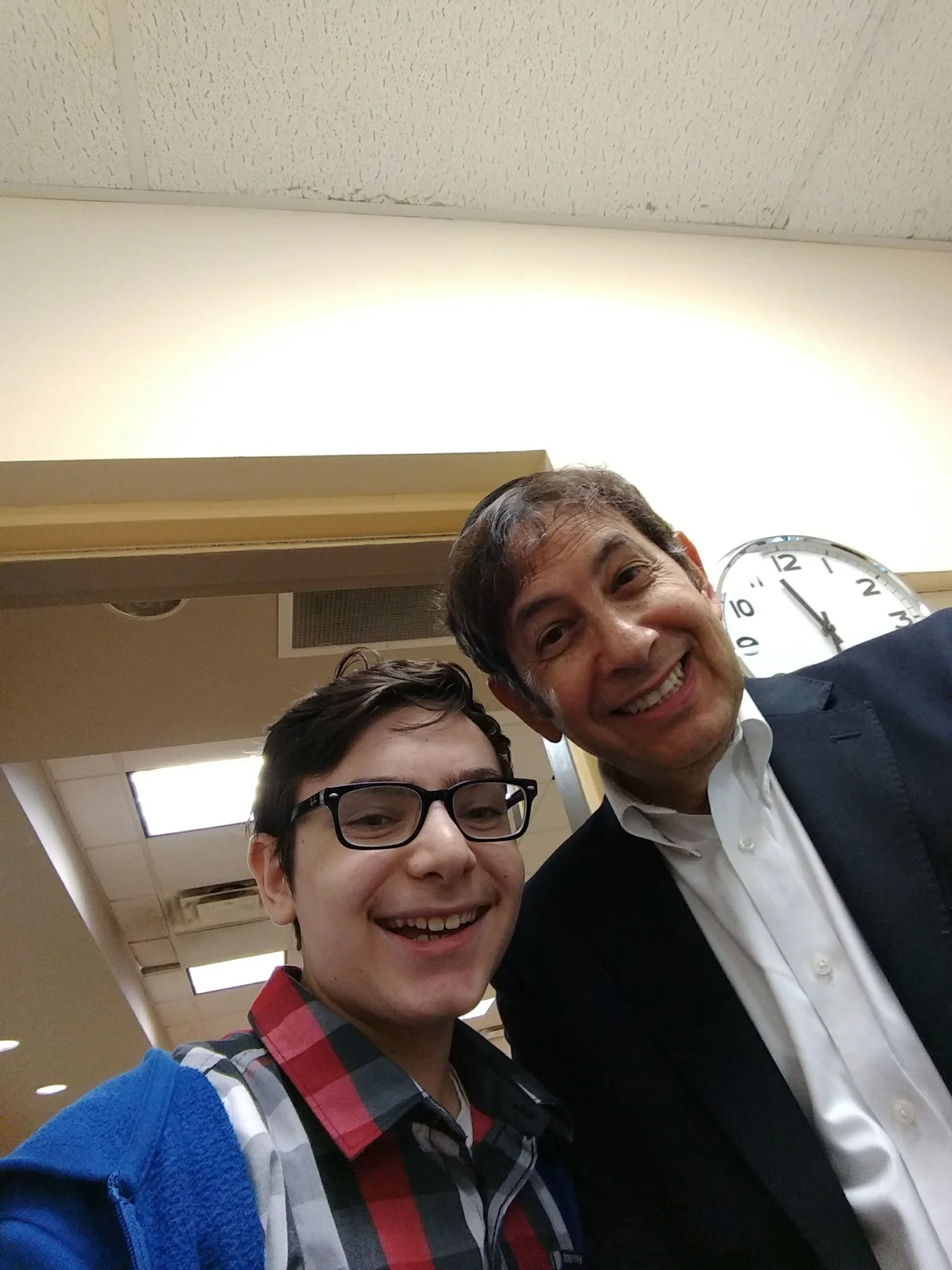
Shalom Korn with Rabbi Ronald Malavsky, who was an assistant dean and general studies principal at the all-boys Jewish private school Shalom attended.
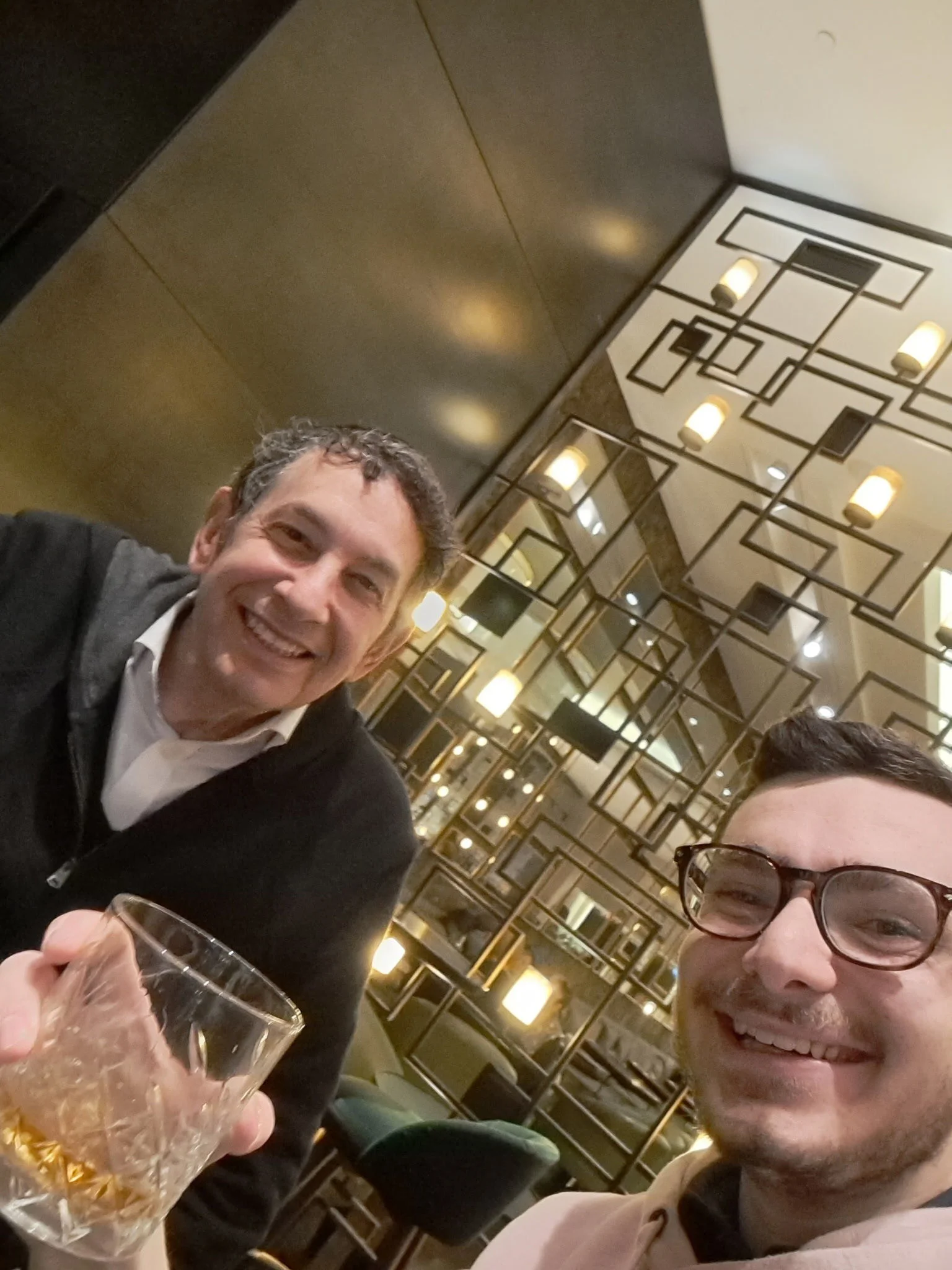
A couple years after he graduated from high school, Shalom reconnected with Ronald Malavsky during a chance meeting in Israel.
HERO BEHIND THE MASK
Shalom’s bedroom is “an eclectic external representation of my personality.” The walls are filled with prints of Monet’s greatest works, juxtaposed with police patches and stickers from his travels around the globe. By his count, Shalom has visited 43 states and six countries, not to mention a weekend jaunt to Puerto Rico with a buddy just days before this interview took place.
“Everything on my wall has a story behind it. And it’s usually a good one.”
Here’s an example: Near Shalom’s bed rests a green graduation cap he wore during his commencement ceremony at Sister Claire Tynan School of Nursing, where he earned an associate’s degree in 2025. On top of the cap, Shalom printed the names of nearly 300 people who had been influential in his life to that point. “Ronald Malavsky” is scrawled in black ink.
“He might be the best educator I’ve ever had, and I am so grateful to him. I would not be where I am now without him. He gave me a way out. When you find someone who believes in you like that, it’s magical.”
To provide context to what transpired during Shalom’s early teen years, it’s important to understand the daily rhythm at Heichal HaTorah. The 26 students in his class progressed through a dual curriculum — general studies such as math and science, along with sacred Jewish texts like the Torah and the Talmud. Some days, Shalom would arrive on campus at 7:30 a.m. and wouldn’t return home until midnight.
“I was in the mainstream Jewish community and it was just expected of us,” he explains. “In a matter of speaking, we were preparing to become rabbis.”
Yet Shalom’s thirst for knowledge wasn’t quenched. Not even close. So during that pivotal freshman year, Ronald gave Shalom a number of books to help him explore the Jewish tradition even deeper.
“That opened up a range of conversations for us,” Ronald remembers. “Judaism is not faith-based — it is fact-based. We don’t just believe for the sake of belief. We analyze our faith.”
Shalom began to text and email his mentor outside of class, peppering Ronald with random thoughts and observations. Ronald asked him to write down a few questions, then the two would meet once a week in his office to talk through them. Shalom jotted some down, all right.
“He came back the next week with two full pages of questions,” Ronald says, laughing. “He’s a thinking person, and I believe the school’s curriculum was holding him back. He had all these questions he couldn’t get answered until we started to meet. We used to joke that we could probably turn our conversations into a book.”
It was a turning point for Shalom. An unconventional teacher delivering what his conventional classes could not.
Ronald continues: “I told Shalom that God had granted him a certain level of intelligence, and that he needed to harness it. It’s like the famous line from ‘Spider-Man’: ‘With great power comes great responsibility.’ I told him, ‘much more will be expected from you.’ ”
He was ready for the challenge, but then a global pandemic arrived. Shalom was a “COVID Kid” in the class of 2020. With the world shut down indefinitely, he felt rudderless in a sea of uncertainty.
But another lifebouy would appear on the horizon — exactly 5,475 miles away.
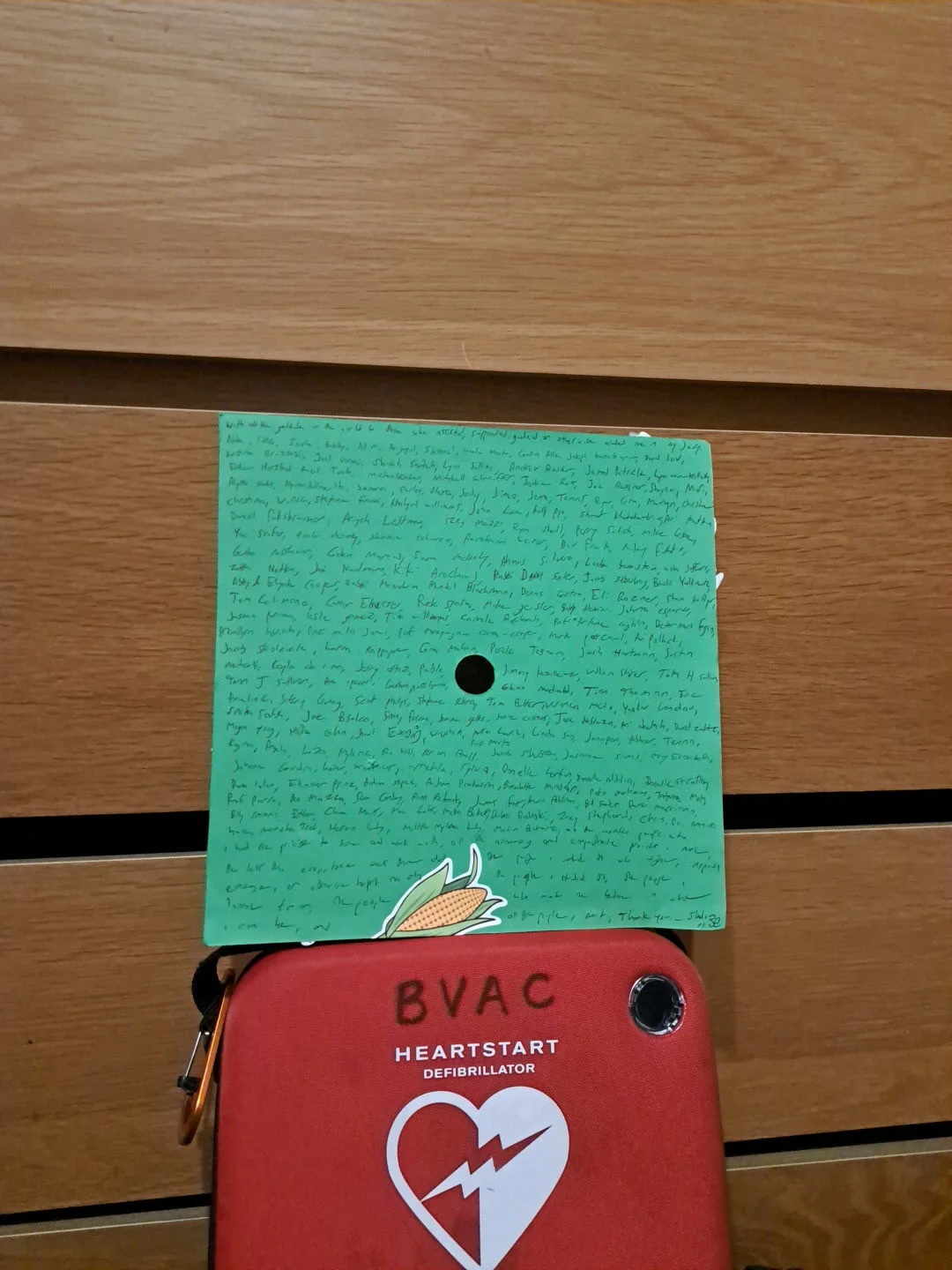
On the flip side of his graduation cap, Shalom has printed the names of nearly 300 people who have influenced his life to this point.
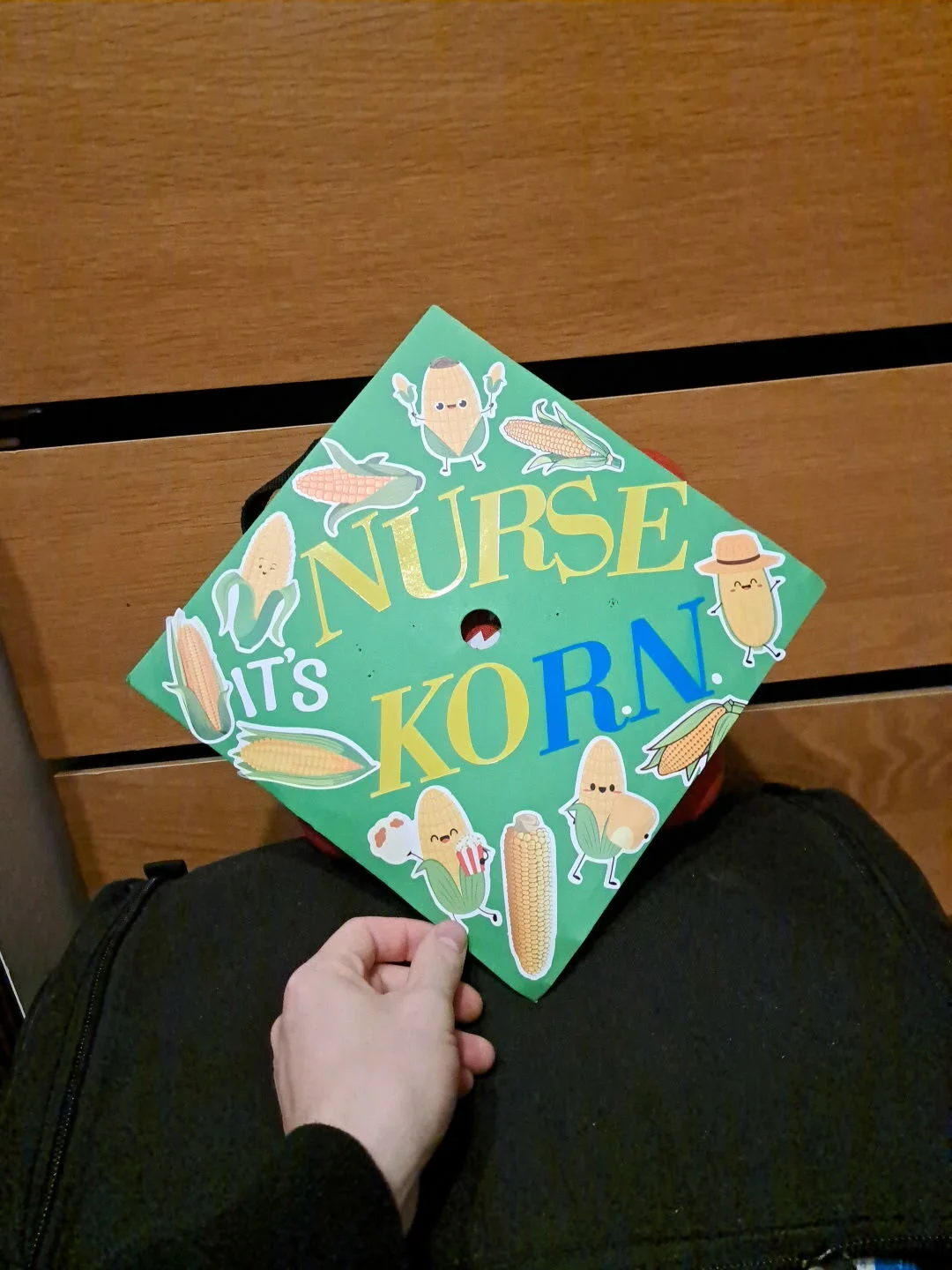
Shalom shows off his college graduation cap that features ‘Corn’ stickers on top.
FOLLOWING THE CROWD
Sheep.
That word appears in the Bible more than 500 times. Makes perfect sense. The human race resembles them more than any other animal.
•Emotionally complex
•Highly social
•Blindly following the crowd to perceived greener pastures
•And sometimes going astray
In addition to the graduation cap, Shalom keeps another item near his bed — a plastic sheep. It’s to remind him of what he once was, and what he experienced in Jerusalem. Graduates of Heichal HaTorah are expected to take a gap year between high school and higher education, so Shalom and several of his classmates ventured to Israel, the birthplace of Judaism, to continue their religious study with the focus of becoming a rabbi.
After months of rigorous learning, Shalom still wasn’t sure what he wanted to do with his life, but he knew exactly what he DIDN’T want to do: a rabbinical career was not for him. Yet he hadn’t reached that conclusion in a classroom. Instead, he was in a field surrounded by 400 sheep. Shalom the student was now Shalom the shepherd.
“What the heck am I doing here?”
That’s what Shalom muttered to himself, again and again, as his body was baking under the blazing sun. A mix of sweat and dust created an uncomfortable paste on his face and arms. Even worse, everything smelled like urine.
The assignment to fill in for a vacationing herdsman was just a week, but Shalom was struggling. Like the sheep, he was living the same day over and over again. Up before sunrise. Still guarding his flock after midnight. Exhausted, and even more unsure of his future.
“I realized that I was no better than the sheep that I was watching. Most everything that I had done had been following what everyone else did. My friends chose one high school? I chose the same. These people went to work at a summer camp? I followed suit. Everyone went to one rigid gap year program? So did I.”
Shalom’s brother is named after Rabbi Akiva, a humble, illiterate shepherd who had transformed into one of Jewish history’s greatest scholars during the Roman Empire. Shalom had become fascinated with his story — seeing parallels to his own life — and even paid a visit to his gravesite in Tiberias, Israel.
“I just sat down on the hillside, looked out at the Sea of Galilee, and meditated. The lesson I took from Akiva’s life? Don’t ever let the conventions of the world lie to you. If you believe in yourself, you can move mountains.”
But first, Shalom would move back to the United States. And go to work in an auto repair shop, of all places.
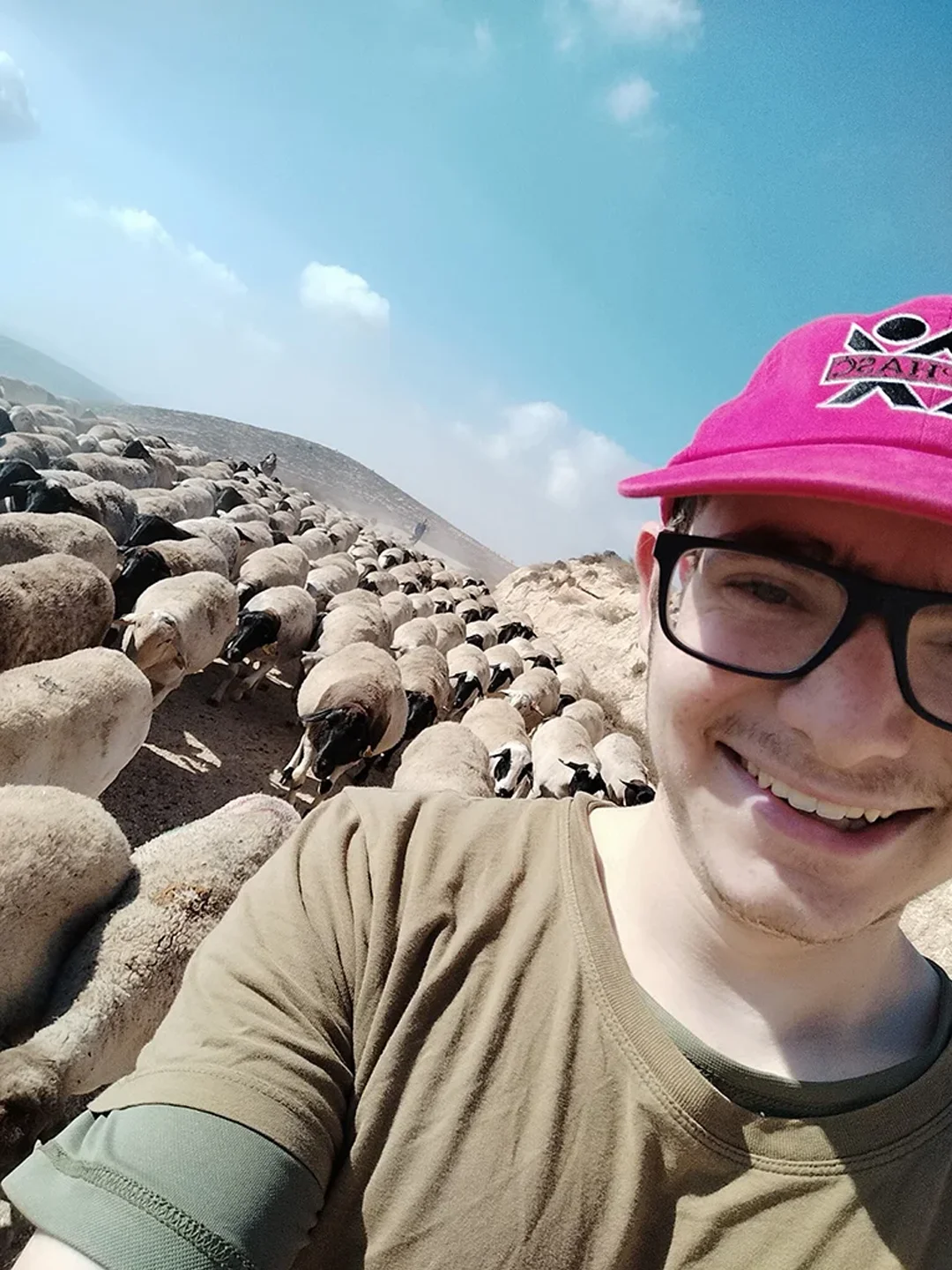
Shalom Korn takes a selfie with the 400 sheep he was responsible for when he was a shepherd in Israel.
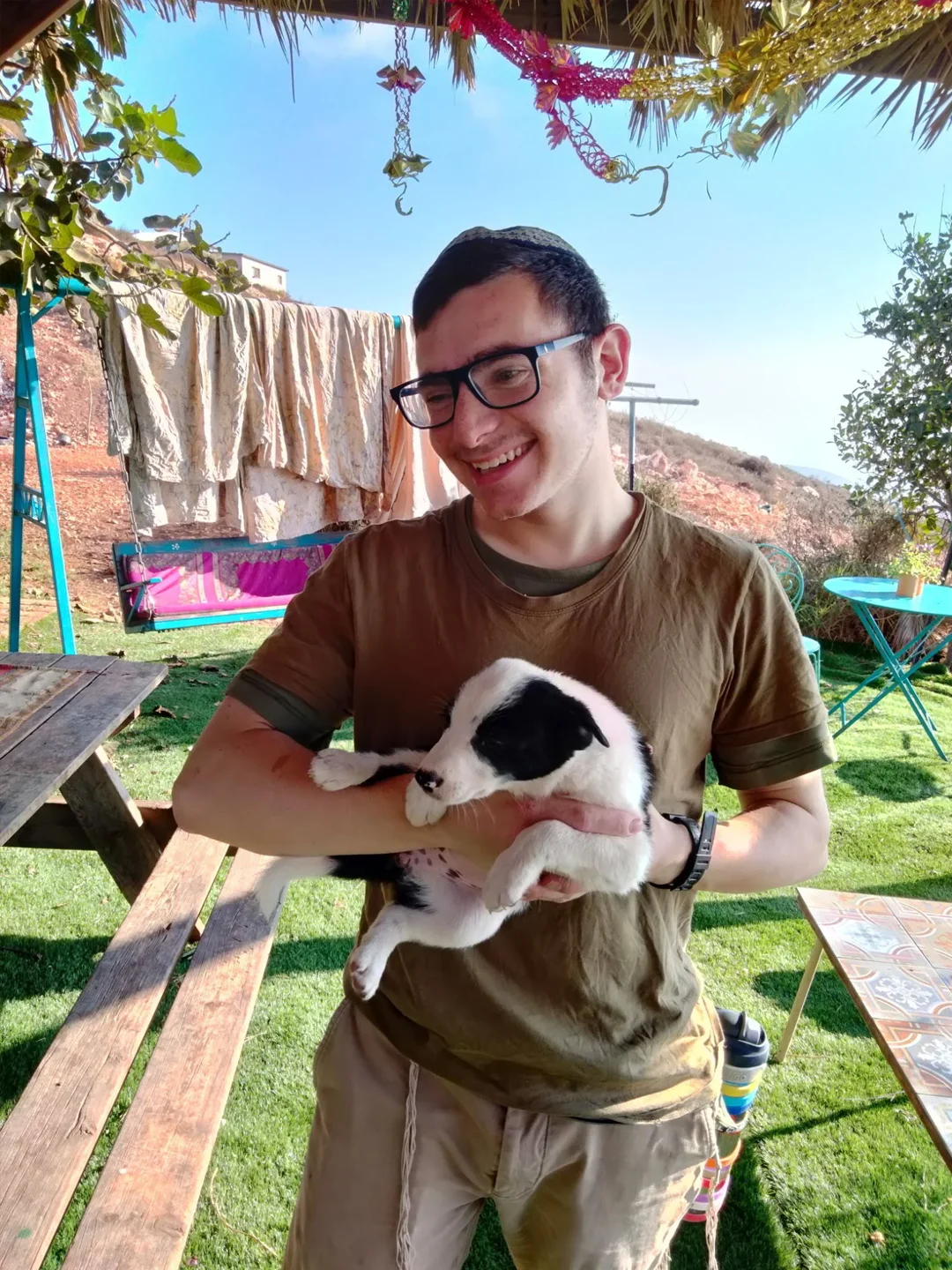
Shalom cradles a sheep dog that was being groomed to round up the herd he was overseeing in Israel.
BOYS UNDER THE HOOD
The door was wide open, yet Shalom knocked anyway. He wanted to collect himself and clear his throat before delivering his big pitch. He was ill-equipped to make the ask, but he certainly was enthusiastic.
Marc Pascual is, too.
Since 2009, Marc has operated the New Bridge Garage in Bergenfield, servicing high-end foreign vehicles such as Porsche, BMW, and Mercedes. He was curious to hear what the young man had to say.
“I have no experience,” Shalom admitted during this impromptu meeting in 2022, “but I love cars. I really want to work for you.”
After a long pause, Marc responded with a question: “When can you start?”
Like many others, Shalom grew bored and restless during COVID, so to pass the time he began poring through automotive magazines and watching YouTube videos. “I would sit on my porch and see cars drive by and I thought, ‘I’d like to learn more about them.’ ”
For the next six months, he not only acquired basic automobile maintenance knowledge from his boss, but something even more important.
“Honestly, I was teaching Shalom about life more than auto repair,” Marc reflects. “Shalom’s a really good guy and open to learning. I’m Catholic, he’s Jewish. We talked a lot about the differences in our faith. We talked about what real success is: if you fail, get back up. We’d have some really deep conversations.”
Shalom returned to the shop on this frigid February afternoon in 2026. Gasoline is $2.79 per gallon at the full-service pumps, and each bay inside has a vehicle up on hydraulic jacks. Marc is busy in the back when a delivery man walks through the front door. Even though it’s been four years since Shalom has worked there, muscle memory takes over and he jumps behind the counter to assist him.
On the wall to his left are blue shelves filled with compliance record manuals, awards for technical excellence, a photo of the Virgin Mary, palm branches, and some Wild Harvest bird seed. A few feet away, a dove Marc rescued from under the hood of a 1997 Corvette he was servicing peeks out from its cage. Marc adopted the bird and it serves as the garage’s unofficial mascot. “Honestly, I don’t have a name for him. When kids come in here with their parents, I let them give him a name. It changes all the time.”
As Shalom watches a pair of technicians work on a cherry red Abarath, he recalls the exact moment he knew it was time to go. He had grown tired of the grease, the noise, and the fumes that exacerbated his asthma. When he broke the news to Marc, the two were under a car replacing brakes.
Marc was disappointed, of course. But knowing Shalom’s engaging personality and his heart to help others, he posed another question: “Have you looked into nursing?”
Shalom had not — at least not yet. “Here’s all I knew about healthcare: nurses worked in big buildings called hospitals, and it looked like they wore pajamas all the time,” he remembers, laughing.
In a stroke of serendipity, he checked his email that same afternoon, and a buddy had sent him a link to register for a local Emergency Medical Technician course. At the time, Shalom couldn’t envision dressing in scrubs and dispensing medications, but he could see himself racing toward 9-1-1 calls.
So with the auto repair shop now in his rearview mirror, Shalom would soon be driving in a new direction.
Buckle up. This is where the ride gets intense.
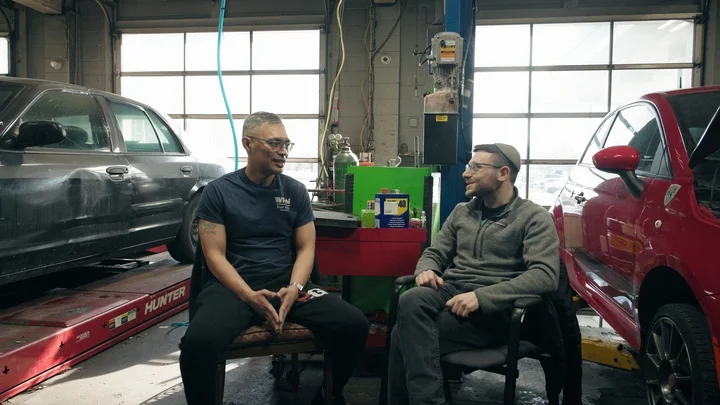
Shalom Korn chats with Marc Pascual, who operates the New Bridge Garage in Bergenfield, New Jersey. Marc hired Shalom to work in his shop despite not having any experience with automobiles.
RACING TO THE RESCUE
“Hop in!” Shalom calls out to a couple of filmmakers shadowing him. He’s behind the wheel of Truck 739 from Bergenfield Volunteer Ambulance Corps Inc., where he’s served as an EMT since 2022. It’s one of five area companies employing him, which includes Englewood Health Medical Center, the first to bring him on board following his certification.
On this afternoon, he’s driving along South Washington Street, which winds through eight different towns and is considered to be the main gateway from New Jersey to Manhattan. He passes a Dollar Mart, an Urgent Care Center, a joint called Bagels Nosh, and a barbershop. “There are, like, 800 barbershops on this block,” he points out, smiling. “If you need a haircut, you’re in the right place.”
Shalom knows, however, that a friendly smile can quickly become a look of concern when an urgent call comes in. Here’s the truth of the matter:
He’s witnessed death — He recalls an elderly caregiver who hanged himself while his wife with dementia was in another room. “He regretted it,” Shalom says softly. “His hands were under the noose. He was trying to get the rope off but the chair had been kicked away.”
He’s heard the last words of accident victims — “There was a man who was hit by a bus. As I’m caring for him he tells me, ‘I’m fine. I’m gonna be OK.’ He was taken to the hospital where he died later that day. I was the last human being he spoke with.”
And he’s been a shining light — “I do a lot of hospice transport, so I’m either driving or in the back holding a person’s hand. I’m moving someone from one place to another for the last time. This woman was in a lot of pain and we were taking her home to die. She realized she left her bag of clothes at the hospital. I went back to get it, then drove to her house to drop it off. She sees me walk in the room and gets this big smile on her face and says, ‘That’s him! That’s the angel wearing a yarmulke.’ ”
It’s simply part of the job. All of it. Sometimes all in one day.
Upon returning to the station, Shalom offers a tour of the building. His fellow drivers at Bergenfield Ambulance are gathered around a table devouring Burger King and chuckling over an episode of “Jackass” on the big-screen TV. Shalom leads his visitors to an upstairs room that features a pair of couches, a pool table, a dart board, and a ping-pong table near the wall. A floor mat reads, “This house runs on red lights and sirens.”
“I did an absurd amount of Portage Learning coursework in this room,” Shalom acknowledges. “My nursing program recommended Portage, and I would recommend it to everyone, too. The courses were challenging, well-formatted, and interesting. I wish I could have spent even more time on the material because of how engaging it was.”
He chuckles.
“Here’s what I tell other people about Portage: You’re quick, you’re cheap, and you get the job done. You’re one of the best options around.”
While Shalom relished the ambulance rescue work, he began to pursue nursing “because there’s an expiration date on everything. Being an entry level emergency services provider is not sustainable as a career.” He completed six courses with Portage Learning, including Introduction to Ethics with Dr. Jonathan Watt, and Anatomy & Physiology with Professor Brandon Zangus. That curriculum served as the bridge to enter the Sister Claire Tynan School of Nursing in 2023.
“He was rock solid academically, and I found him very personable,” Dr. Watt remembers. “His ability to handle things academically AND be able to be so personable and conversant speaks well of his ability to thrive in a nursing program and profession.”
Professor Zangus adds, “He was very respectful and appreciative. He asked good questions, which also will bode well for whatever nursing environment he ends up in.”
And even though he interviewed for his current position while in San Francisco on a road trip with a friend, Shalom ended up in a nursing environment just a few blocks from his home.
And ER patients at Palisades Medical Center are grateful he did.
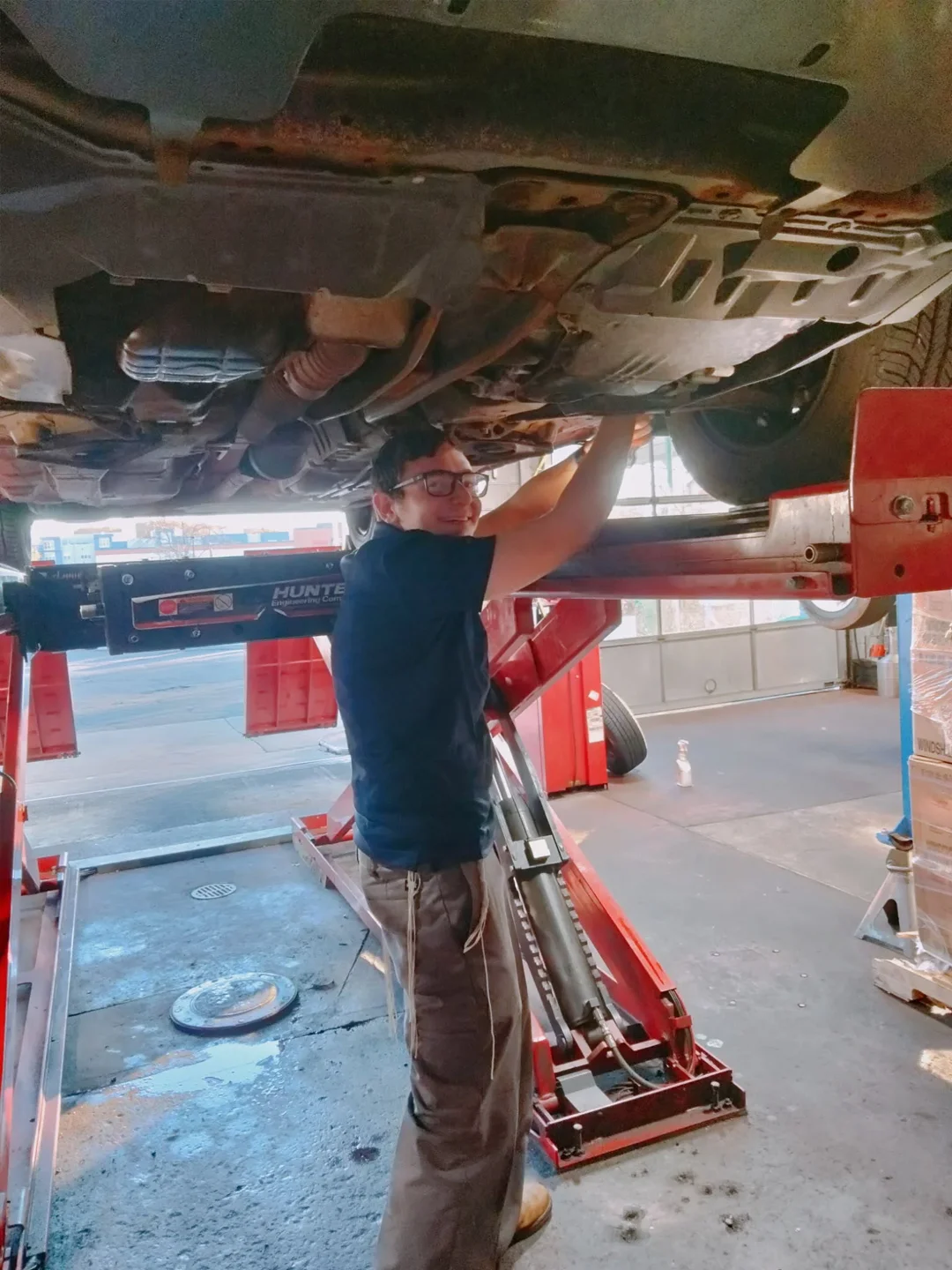
Shalom Korn works on a vehicle at the New Bridge Garage in Bergenfield, New Jersey.
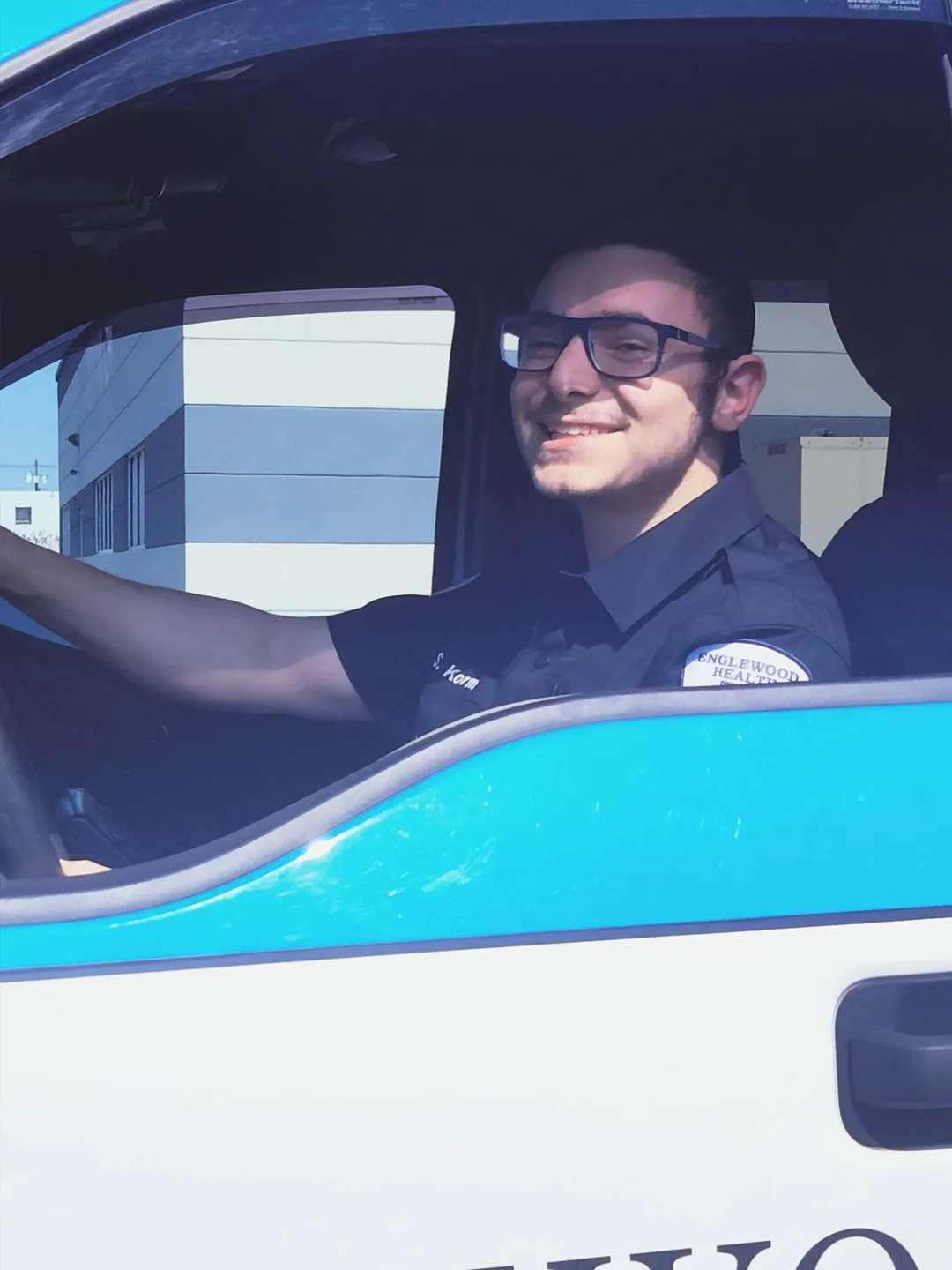
After leaving his job at the auto repair shop, Shalom Korn began working as an Emergency Medical Technician for five ambulance companies.
A DIFFERENT WORLD
Mary McGeever is the public relations director for Hackensack University Medical Center, under which Palisades operates. And she’s had quite a week. Just two days earlier, the hospital opened its new $50 million emergency department, which features two triage rooms for initial medical assessments, eight private rooms and 15 semi-enclosed “treatment pods.” She’s been conducting tours, meeting with physicians and administrators, and juggling media requests from TV stations and newspapers.
She sees a film crew trailing Shalom in the lobby and delivers a hi-five.
“How ya doin’, superstar? Can I get your autograph?”
Shalom giggles and keeps walking. He still has a few things to take care of before his shift begins at 6:45 p.m. The ER is filled with patients, yet none of the 12 nurses on duty looks hurried. They are, however, moving purposely throughout the pristine space.
A woman in obvious pain lies on a gurney and moans. A boy of about 10 or so is hunched over coughing as his mother rubs his back. Standard stuff for a hospital. But an evening in the ER can also have its lighter moments. Two nurses are inspecting patient records when a colleague walks over to where they’re sitting. She nods toward a woman with her hands covering her face.
“Unidentified object up the nose.”
Long pause.
“You guys wanna take this one?”
The parking lot of the medical center offers a gorgeous view of the Manhattan skyline. It’s absolutely breathtaking at night. It’s just across the Hudson River from Bergenfield, yet it feels like worlds apart. New York is called “the city that never sleeps,” and there are two very good reasons why:
1) Honking horns and wailing sirens. Day and night.
2) Wailing sirens and honking horns. Night and day.
Shalom is quite familiar with them all — the sirens, the horns, the night. OK, not so much the day because he’s usually sound asleep. Shalom’s shift runs from 6:45 p.m. to 7:15 a.m.
No matter the hour, you’ll witness flocks of folks shuffling in and out of the subway, in an out of department stores, in and out of Broadway musicals. And it appears there are two important rules these pedestrians follow: walk fast and do not make eye contact — under any circumstances.
The Emergency Department at Palisades couldn’t be more different.
Nor could Shalom.
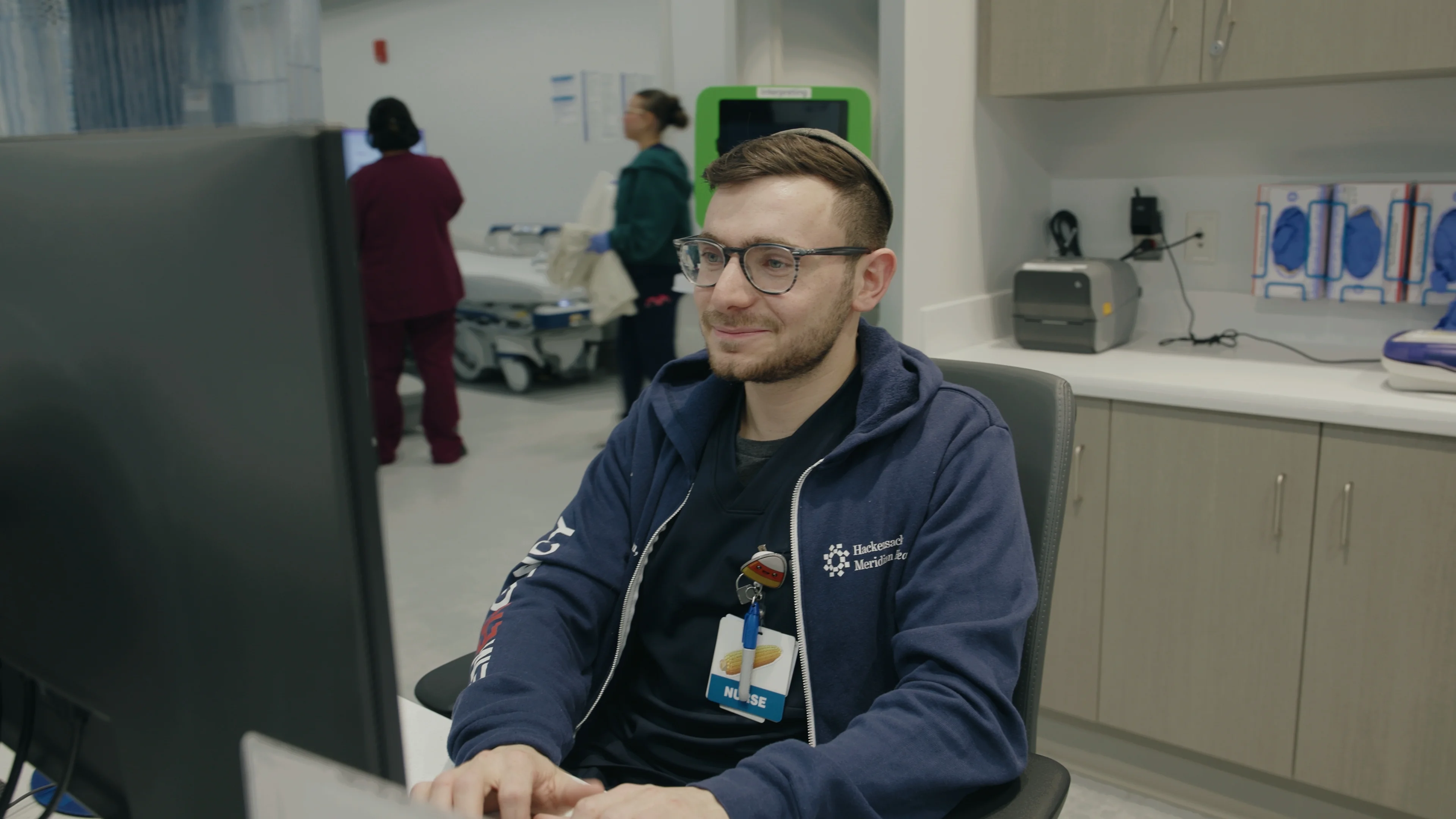
Shalom Korn, now an emergency room nurse at Palisades Medical Center, checks a patient’s records during a recent shift.
A REALLY BLESSED LIFE
Shalom.
That word appears nearly 250 times in the Bible. While common as a greeting in Jewish circles, it actually conveys much deeper meaning: well-being, flourishing, harmony, and peace. Pursuing it fuels his every action — especially his interactions.
At the tender age of 24, he engages deeply in conversation, even while rolling up to the hospital in his black 2013 Charger, the one he purchased from the Teaneck Police Department last year. Despite growing up in the social media age of narcissism, you get the sense he really is interested in what his passengers have to say. So it’s not surprising that in just a few short months Shalom has already made quite an impact on those in his care. He’s a shepherd in scientist scrubs. Equal parts non-conformist nurse who hands out “corn stickers” and fist bumps to his patients, and a non-anxious presence who transforms their inner turmoil into hope for healing.
“I love his enthusiasm,” says Mike Nowatzky, the nurse manager at Palisades Medical Center. “He’s so good with his patients.” Mike hired Shalom in September of 2025 and they not only share a passion for comforting the sick and injured, but the two bonded over their educational background. Mike also studied with Portage Learning, completing statistics and chemistry courses after graduating from Penn State University in 2018.
“In his short time being here,” Mike points out, “Shalom has had ten times as many patient comments as some nurses who have been here five years. Shalom really connects with patients, and he’s able to level with them. He doesn’t just look at the problem — he looks for what the patient needs.”
Here are a few excerpts from Shalom’s five-star Google reviews
“The reason for my experience being as wonderful as it was, was due to one employee, Shalom Korn. He made us feel comfortable and welcome within the busy environment of the ER. He answered any questions we had and explained all his responses amazingly.”
“I want to highlight the excellent care I received from nurse Shalom. He was extremely attentive, kept me informed at all times about my tests, and patiently answered all of my questions. He was not only compassionate toward me, but I also witnessed how caring and respectful he was with other patients as well. Truly the best nurse I have ever had.”
“Our nurse, Shalom Korn, was exceptional — calm, clear, and genuinely caring. He made us feel safe, informed, and supported throughout the visit.”
So after years of struggling with anxiety, undernourished intellectual hunger, and a lack of direction, has Shalom Korn finally arrived in his happy place? Is this world traveler in the yarmulke who listens to Iron Maiden on blast, relaxes with rock climbing, and binges “The Sopranos” — the one who’s impossible to identify with a label — now ready to settle into the label of “emergency room nurse” for his career?
Furthermore, does the affirmation he receives from his patients and superiors confirm that he’s exactly where he needs to be — or does it lead him to believe there’s something more, an even bigger challenge he needs to take on?
“I don’t know. I really don’t,” Shalom concedes. “Honestly, I just want to make it through the next shift.”
He does acknowledge a special concern for children, and he could see himself veering toward emergency care for kids in the years ahead.
“The truth is, I’m living a really blessed life with a lot of joy and curiosity. And I’m learning to stop following the world’s cues — even without knowing what specific destinations are ahead for me.”
Tears well in his eyes.
“No matter where life takes me, I want to be a voice of hope. That’s the story I want to continue to tell.”
Ironic, isn’t it? He thought he was traveling far and wide to experience shalom. But all along, he’s simply been searching for the right place to share it.
(Did you find Shalom’s story inspiring? If he can do it, you can too. And we’d love to walk alongside you through the educational journey. Portage Learning offers 32 asynchronous courses in six fields of study, and credits transfer to 2,800 institutions across the nation. It’s online learning, on your schedule.)
Portage Learning filmmaker Yucheng Jiang offers a different perspective on the career arc of Shalom Korn.


